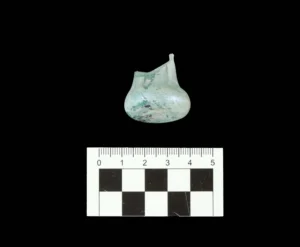

In 1983 York Archaeology excavated the grounds surrounding The Judge’s Lodging in York hoping to find, among other things, remains of St Wilfrid’s Church. In what is thought to be the disused graveyard of the church, they uncovered a fascinating and rare object…a witch bottle.
Between the 16th and 19th centuries, witch bottles were popular items of protective magic. During the early half of this period, when witch hunts and trials were most prevalent, protection magic was at its height. It is believed that a person who thought they had been bewitched would use a witch bottle to either undo the curse or turn the curse back onto the witch. Across the UK, they have been found hidden in walls, below hearths, and under floors (possibly with the aim of protecting the whole household) as well as in churchyards, ditches and riverbanks.
Witch bottles are usually stoneware flasks and can be filled with all sorts of “personal” items including human and animal hair, urine, animal bones and small pieces of textile. The neck of the bottle is then blocked off by a cluster of metal pins, nails or wire, and the vessel’s cork added to seal it up. The folklore explaining how a witch bottle works varies across different historical records. Common ideas include the theory that the metals objects in the neck would catch the evil spell, that if you kept the contents of the bottle warm this would inflict ongoing pain on the original curse casters (a bit like a voodoo doll), and that once the evil-doer had died the bottle would break.
Hidden on hallowed ground

The witch bottle found in York is of particular interest because it is thought to be the most northerly discovered example of this magical practice from this period. The stoneware flask itself dates from the 16th century, but was found in the archaeological layer dating to the 17th century. This means that the flask was already an antique before it was used as a witch bottle and buried. It was found with the cork still in place, leading archaeologists to believe it to be simply an excellent example of a complete stoneware flask. Over time the cork shrank and became dislodged, revealing a tangle of copper-alloy pins in the neck. The flask was then x-rayed and analysed to reveal its true identity.
There is still a lot to be learnt about witchcraft and the beliefs surrounding it. During the period when witch trials were being conducted in England, which spans more than 250 years, attitudes fluctuated. The lines between medicine, superstition and religion were often blurred. Witch bottles are the perfect example of these divided opinions. The original curse was considered evil, black magic but the protective magic provided by the witch bottle is innocent white magic. It’s all magic, and therefore witchcraft, but who decides where the line between acceptable and unacceptable lies? What constituted punishable witchcraft to one person was another person’s superstitious healing token or religious relic. It must have been a very confusing period for most people and perhaps personal opinions wavered depending on an individual’s changing circumstances or needs.
How to undo a curse
The witch bottle found at The Judge’s Lodging can only give us a small insight into the magical practices of 17th century York. What it can tell us is that firstly there were people using different forms of witchcraft (good or evil) in their everyday lives. And secondly, that there was a belief that witches couldn’t set foot onto the hallowed ground of a church. After all, the York witch bottle was found buried in the church’s graveyard. Considering it was left undisturbed, unopened and unbroken for hundreds of years, perhaps you can draw your own conclusions about how accurate that second belief might be!
Project Reports
A Witch bottle from Judges Lodging, York by N. Rogers
A Witch Bottle from the Judges Lodging, York, And its 16th and 17th Century Context by M Whittaker
Witch Bottle Judge’s Lodging 1983.45 SF271 Report on Fibre Analysis by Dr. M. Gleba