A Cemetery of Secrets
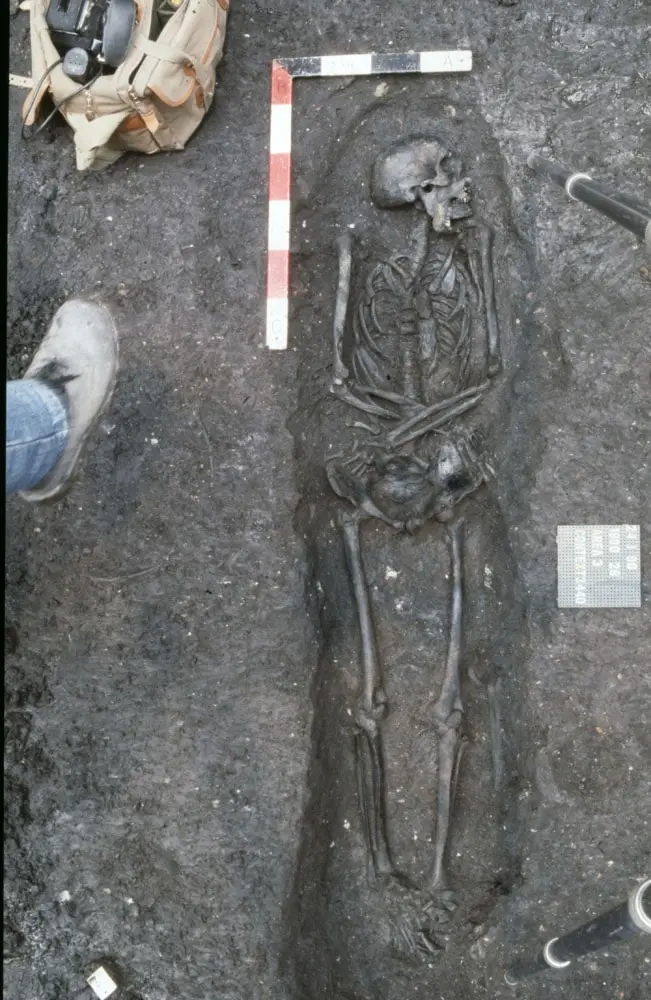
In 2004/5, 59 inhumations and 13 cremated burials were excavated at 3 Driffield Terrace; part of the vast Roman cemetery situated on the Mount, outside the city walls. A few months later, 23 inhumations and one cremation were uncovered at 6 Driffield Terrace. They were all young male adults. Cuts to the neck bones of 40 individuals (48.7%) indicated they had been decapitated, but the number of decapitations could have been higher. Several individuals had their heads placed in the graves in unusual positions, such as near the feet.
25 of the decapitations from Driffield Terrace were by a single cut to the neck. The direction of multiple cut marks on some of the skeletons suggested that the victim was relatively still and the majority of blows were delivered from behind. As well as the decapitations, there were unhealed blade injuries, fractures and evidence of a large carnivore bite mark.
These decapitated burials from Driffield Terrace have been the subject of wide interest and there are many theories as to who they were; whether gladiators, soldiers, criminals or slaves.
The high proportion of younger adult males and frequency of violent trauma could indicate they were gladiators. The demographic profile at Driffield Terrace most closely resembles a burial ground of the 2nd and 3rd century AD at Ephesus, in ancient Greece. Excavated in 1993, this has been interpreted as a burial ground for gladiators.
The Roman army had a minimum height for recruitment and fallen soldiers would match the young adult profile of the Driffield Terrace cemetery. The mix of adults from Britain and abroad in this burial ground could suggest the later practice of enlisting soldiers locally.
The burials took place over the 2nd and 3rd centuries AD, possibly into the 4th. This disproves the theory that the burials are the result of a “mass execution” of members of the Imperial Court after Emperor Septimius Severus’ death in York in AD 211.
The relative uniformity in age and sex of the individuals, their above average height, and their burial in the area of The Mount, one of the most high-status cemeteries of Roman York, does not suggest that they were slaves.
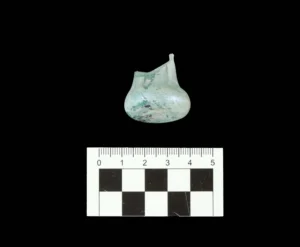
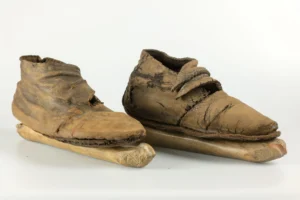
The discussion continued through this multi-faceted project which provided a series of training opportunities, new genomic, isotopic and osteological research, and resources to create a touring exhibition ensuring that this important element of our collection was made accessible to a much wider UK based audience. Finds from this exhibition can be viewed on our Collections website.
Reconstructing a Roman Face
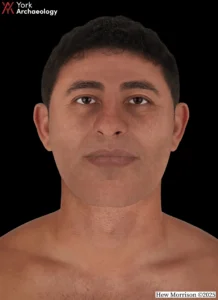
The face of a man of Central European origin excavated at Driffield Terrace has been digitally reconstructed in partnership with the Centre for Anatomy and Human Identification of the University of Dundee. Facial reconstructions are made by specialist forensic anthropologists who rely on measurements and landmarks (standard reference points) on the human skull to add the missing layers of muscle to the bone. This allows them to reconstruct the contours of a person’s face, including the shape of the eyes, nose and mouth. A forensic artist then adds interpretative details such as possible eye and skin colour and hairstyles.
The process of reconstruction
This fascinating video takes the viewer through the process of facial reconstruction.
The final touches
The finished reconstruction brings the viewer face to face with an inhabitant of Roman York.
Project Reports
Driffield Terrace by K. Hunter-Mann
Selected Roman Small Finds from the Cemetery at nos. 3 and 6 Driffield Terrace, York by H.E.M. Cool
‘Gleaming, white and deadly’: Using lead to track human exposure and geographic origins in the Roman period in Britain by J.Montgomery et al.
‘The Headless Romans’: Multi-isotope investigations of an unusual burial ground from Roman Britain by G. Müldner et al.
Preservation of the metaproteome: variability of protein preservation in ancient dental calculus by Meaghan Mackie , Jessica Hendy , Abigail D. Lowe , Alessandra Sperduti, Malin Holst, Matthew J. Collins & Camilla F. Speller
‘La sepoltura romana con anelli in ferro di Driffield Terrace, York’ by Giulia Gallio (in Italian)
Unearthed Issue 1 – 3 Driffield Terrace, York: Vertebrate remains analysis by A. Foster
Unearthed Issue 3 – 6 Driffield Terrace, York: Vertabrate remains analysis by A. Foster and D. Jaques
Unique osteological evidence for human/animal gladiatorial combat in Roman Britain by T.J.U. Thompson et al
Osteological Report
Kurt Hunter-Mann on Driffield Terrace
Site director Kurt Hunter-Mann discusses the skeletons and finds made at Driffield Terrace.
Rui Martiniano on Driffield Terrace
Rui Martiniano, researcher on ancient human genomics, shares his insights on the Driffield Terrace skeletons.
Janet Montgomery on Driffield Terrace
Dr Janet Montgomery, from the University of Durham, explains how isotopic analysis has been used to develop our understanding of the Driffield Terrace skeletons.
David King on Driffield Terrace
Dr David King, a doctor at York hospital, describes the process of CT scanning and how it has provided us with a unique portrait of some of the Driffield Terrace skeletons.